

THE PHILOSOPHY OF MASONRY – PART IV
Five Lectures Delivered under the Auspices of the Grand Master of
Massachusetts, Masonic Temple, Boston
by
Brother Roscoe Pound
Professor of Jurisprudence in Harvard University
IV PIKE.
WE come now to a radically different type of Masonic philosophy. To Preston Masonry is a traditional system of knowledge and its end is to impart knowledge. Hence he thinks of the relation of Masonry to education. To Krause it is organized morals and its end is to put organized mankind behind the universal moral ideas of humanity. Hence he thinks of the relation of Masonry to law and government. To Oliver it is a mode of approach to God and its end is to bring us to the Absolute by means of a pure tradition. Hence he thinks of the relation of Masonry to religion. Pike gives us instead a metaphysic of Masonry. To him Masonry is a mode of studying first principles and its end is to reveal and to give us possession of the universal principle by which we may master the universe. Hence he thinks of the relation of Masonry to the fundamental problems of existence. In part this view was inevitable in one who thought and wrote in a country under the influence of the transcendental philosophy. In part also it was to be expected in a member of a profession whose philosophical ideas, so far as its leaders held any at all, were thoroughly Hegelian. In part it grew out of Pike’s wide reading in the philosophical writings of antiquity and his bent for mysticism. Thus his philosophy of Masonry is a product of the man and of the time and we must look first at each of these in order to treat it intelligently.
1. The man.
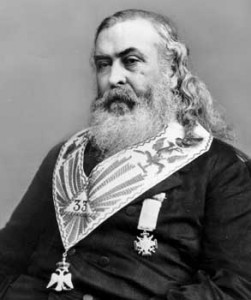
Albert Pike was born in Boston, December 29, 1809. He died in 1891.
Albert Pike was born in Boston, December 29, 1809. His parents were poor. He was educated in the public schools in Boston and it is interesting to know as a means of comparing those days with these that, although he passed the examinations for admission to Harvard College, he was unable to enter because in those days the requirement was that two years’ tuition be paid in advance or secured by bond. He became a school teacher and taught in country schools in Massachusetts from 1825 to 1831. In 1831 he went west and joined a trading party from St. Louis to Santa Fe. Santa Fe was then in Mexico and the journey at that time was a perilous one through a wilderness inhabited only by Indians. On his, return he traversed the Staked Plains and the Indian Territory and settled finally at Van Buren in Arkansas where he opened a school.
At that time political feeling in Arkansas was very bitter. The territory was divided between the Conway party who were politically democrats and in truth were a sort of clan as well, and the Crittenden party who were Whigs politically but were in truth more a personal faction than a political party. Bloodshed was frequent and in many respects there was a feud between the factions quite as much as a political rivalry.
The early experience of this era of feud and private war on the frontier is worth remembering in connection with many things in Pike’s lectures upon Masonry. Pike was a Whig and as such published in the Whig organ at Little Rock some articles of such force as to attract general attention. Accordingly Crittend, the Whig leader, sought out Pike in his country school-room and induced him to go to Little Rock as one of the editors of the party organ. This was his opportunity and he improved it to the full by studying law while, also at work upon the paper. In 1834 he was admitted to the bar and he rose rapidly to the first rank in the profession in Arkansas. Among his earlier achievements was the preparation of the first revision of the statutes of that state. The book does not bear his name but contemporary accounts tell us that he had the chief part in framing it. By general consent it is a model of what such a work should be.
At the outbreak of the Mexican war Pike entered the service and was in action at Buena Vista. His courage, proved already in the political conflicts of territorial days, was again shown in events that grew out of the campaign in Mexico. Pike felt it his duty to criticise the military conduct of Governor Roane and as a result was compelled to fight a duel. The duel took place over the line in the Indian Territory. Happily it was bloodless and ended in reconciliation. There is good reason to suspect that some traces of this experience are to be seen in his lectures.
From 1853 to 1857 Pike practiced law in New Orleans. Thus he was led to make a diligent and characteristically thorough study of Roman law, the basis of the French law which obtained then, as it does now, in Louisiana. In 1857 he returned to Arkansas and afterward sat upon the supreme bench of that state. At the outbreak of the Civil War he cast his lot with the South. As he had great influence with the Indians he was sent to raise a force in the Indian Territory. In this work he was vigorous and untiring. But his utmost efforts could not make obedient or efficient soldiers out of the large force which he was able to raise. Some of the doings of this force have left a stain upon his memory, which, according to the best authorities obtainable, seems to be undeserved. In truth his experience was not very different from that of the British officers during the Revolution and during the War of 1812 who sought to make military use of Indian allies. In any event the project failed. This experience also has left more than one trace in his Masonic lectures. After the Civil War he practiced law for a time in Memphis. In 1868 he went to Alexandria, Virginia, and in 1870 moved across the river to Washington where he practiced law for twenty-one years. He died in 1891.
Albert Pike was a man of the widest and most varied learning. He was a strong and successful common-law lawyer. He had studied the Roman law to good purpose and left a manuscript of a three-volume book upon the principles of the Roman law which is now in the library of the Supreme Court of the United states. But he had many scholarly interests outside of his profession. He left among his papers a manuscript translation of the Zend Avesta and of the Rig Veda in twenty-two large volumes copiously annotated. Moreover he made some mark as a poet. Some of his poems, particularly a striking one upon the battle of Buena Vista, are still to be found in school readers and his verses were formerly much in vogue. Reviewing his extra- Masonic record for a moment, we see a man born and educated in New England, a pioneer in the southwest in its frontier period, a soldier in two wars, a successful lawyer under each of the two great systems of modern law, for a season judge of a supreme court and withal, though largely self-educated, a man of learning and culture who, along with a treatise upon the principles of Roman law which bore immediately upon his profession, could write verse of some merit and could busy himself in the translation of the great books of Oriental philosophy and religion.
But the field of Pike’s most fruitful labors was Masonry. His career as a Mason is too recent and his standing as a Masonic scholar is too well- known to all of you to call for any statement in this place. But I may remind you that he became Sovereign Grand Commander of the southern jurisdiction in the Scottish Rite in 1859 and devoted the remaining thirty-two years of his life in continually increasing measure to the work of that rite. Excepting Krause no mind of equal caliber has been employed upon the problems of Masonry. And Krause, great scholar and philosopher as he was, had lived only in the cultured serenity of German university towns whereas Pike had lived in staid Boston and turbulent territorial Arkansas, had been compelled by local public opinion to fight in a duel, had fought in two wars and had commanded Indians. Moreover, Krause’s Masonic experience was negligible in comparison with that of this veteran of American Masonry. Accordingly we need not hesitate to pronounce Albert Pike by far the best qualified by nature, experience of life, Masonic experience and Masonic learning of those who have thought upon the problems of Masonic philosophy.
2. Now as to the time.
In the earlier part of his career, Pike was brought into contact with the eighteenth-century political philosophy which became classical in American political thought because it was the philosophy of the framers of our constitutions and bills of rights and entered into the framework of our institutions in their formative period. Also in this part of his career, in his study of law, he came in contact with the eighteenth-century legal philosophy of the American common-law lawyer. In the latter part of his career, in his wide philosophical studies, he was brought into contact with the prevailing metaphysical method of the nineteenth century, with the conception of the Absolute, which governed in English philosophical writing, and with the method of unifying all things by reference to some basic absolute principle which prevailed down to the new century. This same period saw the general rise of materialism in the wake of decay of dogma and the triumphant advance of the natural sciences, and this movement so far affected his thought as to turn him, by way of reaction, to mysticism. Indeed a mystic element is to be found not uncommonly in thorough- going idealists. For example the leader of the new school that builds on Hegel’s philosophy has been reproved for dragging mysticism into so prosaic a subject as the philosophy of law. But mystics are made by nature, and nature made Pike one of the greatest of them. Hence we may be confident that reaction from materialism merely accentuated an element which in any event would have been prominent in his thinking and writing. Each of the four points of contact with American thought in the nineteenth century requires a moment’s consideration.
American political philosophy in the first half of the nineteenth century was a compound of English law and French speculation. Prior to the Revolution in the Declaration of Rights of the Continental Congress the colonists had relied upon the common-law rights of Englishmen as asserted by English lawyers and English judges against the Stuart kings in the seventeenth century. But the Declaration of Independence relied instead upon the natural rights of man, a supposed body of universal, eternal, inalienable rights deduced by reason from the nature of man in the abstract. Under the influence of English thinkers of the seventeenth century and of the Continental philosophy of law in the period after Grotius, the French writers of the eighteenth century had developed this theory of natural rights to a high degree, and the founders of our government were deeply read in their writings. But they were also deeply read in Blackstone and in Coke, the oracle of English law. Naturally they combined the general theory of the French speculators and the concrete details of the English lawyers and came to hold that the common-law rights of Englishmen found in their law books were the natural rights of man found in their French political philosophy. Hence in our bills of rights they laid down the former section by section and enacted them in fixed and precise rules on the authority of the latter. This had important consequences for the American legal philosophy which Pike absorbed in the formative period of his study for the bar.
In the contests between the English judges and the Stuart kings the judges had claimed to stand between the rights and liberties of the individual Englishman and arbitrary oppressive action on the part of the crown. When we took over the theory of eternal, inalienable natural rights and combined it with the theory of the English lawyers, the result was a doctrine that law stands and must stand between the individual on the one hand and state and society on the other hand and that its function is to secure the individual in his natural rights against the aggressions and oppressions of organized society. This idea of the mediating function of law, as a reconciling of the individual and the whole, which the lawyer of the last century took for the first article of his creed, is to be seen throughout Pike’s lectures and lent itself readily to his generalization of equilibrium or balance as the Ultimate Reality. For if law was a mediation, a harmonizing, a reconciling, and the universe was governed by law, the fundamental principle of the universe was the mediating or harmonizing which he called equilibrium.
When, in his later studies, Pike came upon the metaphysical method of nineteenth-century philosophers, it was easy to confirm the views to which his acquaintance with the classical American political and legal philosophy and his reading of French Masonic writers of the eighteenth century had led him. For the generation that followed Hegel sought to explain the universe as the realization of an idea. History was the unfolding of that idea in human experience. Philosophy was a logical unfolding of the same idea. Hence the quest was for the one fundamental idea of which the seemingly complex order of the phenomenal world was but a manifestation. Hence the task of the philosopher was to unite and reconcile all differences in the Absolute which he reached through this idea. Traces of the transition from the legal and political analogy to this metaphysical foundation may be seen here and there in those parts of Morals and Dogma which, we may suspect, remained in their earlier forms despite his repeated and thorough-going revisions.
In his later studies Pike was also compelled to take account of the materialism which held its head so high and with “a mouth speaking great things” grew so confidently dogmatic during the last third of his life. If Pike, who was naturally a mystic, seems sometimes to rely on intuition more than on reason, to put faith, which is self-justifying, at the bottom of knowledge, to find a reality in the occult, and to show a conviction of the relation of the symbol to the thing symbolized, in contrast with the rigorous metaphysic of the lectures where he argues and demonstrates instead of prophesying, we must consider the impatience of an idealist and a mystic with the mechanical universe of the positivists and the economic ethics and belly-philosophy of the materialists which a new generation was asserting all about him.
3. Let us turn now to Pike’s Masonic philosophy.
Pike did not leave us any compendium of his philosophical views. Hence we cannot, as in the case of Oliver, apprehend them at a glance from a concise exposition. The student of Pike’s Masonic philosophy must read and study the teeming pages of Morals and Dogma. After reading and reflection the system of philosophy expounded will make itself felt. But it is quite impossible for the reader to put his finger upon this sentence or that and say here is Pike’s philosophy in a nut-shell. For the first thing to bear in mind in reading Morals and Dogma is that we must discriminate closely between what is really Pike and what is not.
Indeed he has told us this himself.
“In preparing this work, the Grand Commander has been about equally Author and Compiler; since he has extracted quite half its contents from the works of the best writers and most philosophic or eloquent thinkers. Perhaps it would have been better and more acceptable, if he had extracted more and written less.
“Still, perhaps half of it is his own; and, in incorporating here the thoughts and words of others, he has continually changed and added to the language, often intermingling, in the same sentences, his own words with theirs.”
In some measure the author is unjust to himself in this statement. In a sense the book is all his own. He read and digested everything. He assimilated it. He made it part of himself and worked it into his system. But for this very reason texts from Pike and excepts from Morals and Dogma are more than usually deceptive. We may fasten almost any philosophical idea upon him if we proceed in this way. We may refute almost any page by any other page if we look simply at the surface and do not distinguish matter which he is adapting or is making use of to illustrate the development of thought upon the subject from dogmatic statements of his philosophy. Morals and Dogma must be read and interpreted as a unit. As Immanuel Kant said of his own writings, it is a book to think through not merely to read through.
Three contributions of the first moment to Masonic science deserve to be noted before taking up Pike’s philosophy of Masonry in detail. In the first place Pike was the apostle of liberty of interpretation. He insisted in season and out of season that no infallible authority speaking excathedra could bind the individual Mason to this or that interpretation of the traditional symbols of the Craft. He taught that the individual Mason instead of receiving a pre-digested Masonry ladled out to him by another should make his own Masonry for himself by study and reflection upon the work and the symbols. Thus he stood for thorough going individual Masonic development. He stood for a Masonry built up within each Mason by himself and for himself on the solid foundation of internal conviction. This Masonic Protestantism, as it might well be called, is especially interesting in one who was so thoroughly filled with French writings upon Masonry. Secondly he gave us a genuine interpretation of the symbols which came into Masonry through the hermetic philosophers. Hutchinson and Preston and even Oliver in many cases did not understand these symbols at all. Indeed Preston was much less interested in what they really were than in how they might be made instruments of education in his time and place. Accordingly Preston and Oliver gave currency to inadequate and often ignorant explanations of ancient symbols. Pike studied their history and development. He mastered their spirit and perceived their place in the evolution of human thinking. Hence he was able to replace the crude symbolism of the end of the eighteenth century by a real science of Masonic symbols. In the third place not only did he interpret our symbols but he enriched the symbolism of the Craft from a profound acquaintance with the ancient and modern literature of symbolism and mysticism. Thus he made us aware that the science of Masonic symbols is but part of a much wider subject, that it is not self-sufficient and that the serious Masonic Student has much more to study than he can find within the covers of an exclusively Masonic library.
I can do no more than give you a key to what I conceive to be Pike’s philosophy of Masonry. Perhaps the first point to make is that in nineteenth-century America philosophy was regarded, under the influence of Herbert Spencer, as the unification of knowledge. Moreover the metaphysical method of the first half of the nineteenth century, when Pike’s ideas were formative, was to endeavor to explain everything in a “speculative, metaphysical way by a spiritual, logical principle.” But it so happened that all antiquity had been making a like search for the One but for a different sort of One. The earlier Greek philosophers sought a single element to which the whole universe might be reduced. The Ionian philosophers sought to find such elements in air or fire or water or, as one of them put it, “a primordial slime.” Oriental thinkers had usually sought an absolute word which was to be the key of all things. Others among the ancients had sought an absolute principle. With vast labor Pike brings together all that ancient and Oriental peoples thought and wrote and all that mystics have since thought and written with the ideas of the Orient and of antiquity as a basis and upon this foundation he sets forth to work out a system of his own.
Pike starts with a triad. This is suggested by the ancient conception of the number three as the symbol of completion or perfection. The singular, the dual and the plural, the odd and even added, was thought of as a complete system of numbers. Hence the number three was perfection in its simplest form; it was the type or the symbol of perfection. He finds a triad everywhere in ancient thought and in every system of the occult and in every mystic philosophy. He finds it also in all Masonic symbolism and from end to end in our lectures. Accordingly he seeks to show that in its essentials this triad is at all times and in all its forms the same triad. Wisdom, strength, beauty; intelligence, force, harmony; reason, will, action; morals, law, social order; faith, hope, charity; equality, liberty, fraternity–all these he shows are the same triad in various forms. There is a fruitful passive principle which is energized and made productive by an active, creative principle and there is a product. As he shows, Osiris, Isis and Horus symbolize this with the Egyptians and he traces the same reduction of the universe to these fundamental through every type of ancient mystery and all mystic speculation. In Morals and Dogma he makes all manner of application of this idea to politics, to morals and to religion. He carries it into every type of human spiritual activity and gives the most copious and learned illustrations.
But this of itself would be barren and would end in pluralism. Accordingly he conceives that these three things are emanations, or better, are manifestations of the Absolute. This idea again he subjects to the test of application to all that has been thought and written by mystics down to his time. We find a unity in the Absolute. But how do we unify the manifold, the infinite manifestations of the Absolute in our experience ? Is there here some one principle? Pike says there is and that this unifying principle is equilibrium or balance. The result of the action of creative, active energy and productive, passive receptivity is in the end a harmony, a balance, an equilibrium. He then applies this idea of equilibrium to every field of thought. One example will suffice.
“It is the Secret of the Universal Equilibrium:– “Of that Equilibrium in the Deity, between the Infinite Divine Wisdom and the Infinite Divine Power, from which result the Stability of the Universe, the unchangeableness of the Divine Law, and the Principles of Truth, Justice, and Right which are a part of it; . . .
“Of that Equilibrium also, between the Infinite Divine Justice and the Infinite Divine Mercy, the result of which is the Infinite Divine Equity, and the Moral Harmony or Beauty of the Universe. By it the endurance of created and imperfect natures in the presence of a Perfect Deity is made possible;
“Of that Equilibrium between Necessity and Liberty, between the action of the Divine Omnipotence and the Free-will of man, by which vices and base actions, and ungenerous thoughts and words are crimes and wrongs, justly punished by the law of cause and consequence, though nothing in the Universe can happen or be done contrary to the will of God; and without which co-existence of Liberty and Necessity, of Freewill in the creature and Omnipotence in the Creator, there could be no religion, nor any law of right and wrong, or merit and demerit, nor any justice in human punishments or penal laws.
“Of that Equilibrium between Good and Evil, and Light and Darkness in the world, which assures us that all is the work of the Infinite Wisdom and of an Infinite Love; and that there is no rebellious demon of Evil, or Principle of Darkness co-existent and in eternal controversy with God, or the Principle of Light and of Good: by attaining to the knowledge of which equilibrium we can, through Faith, see that the existence of Evil, sin, Suffering, and Sorrow in the world, is consistent with the Infinite Goodness as well as with the Infinite Wisdom of the Almighty.
“Sympathy and Antipathy, Attraction and Repulsion, each a Force of nature, are contraries, in the souls of men and in the universe of spheres and worlds; and from the action and opposition of each against the other, result Harmony, and that movement which is the Life of the Universe and the Soul alike…
“Of that Equilibrium between Authority and Individual Action which constitutes Free Government, by settling on immutable foundations Liberty with Obedience to Law, Equality with Subjection to Authority, and Fraternity with Subordination to the wisest and the Best: and of that Equilibrium between the Active Energy of the Will of the Present, expressed by the Vote of the People, and the Passive Stability and Permanence of the Will of the Past, expressed in constitutions of government, written or unwritten, and in the laws and customs, gray with age and sanctified by time, as precedents and authority;
“And, finally, of that Equilibrium, possible in ourselves, and which Masonry incessantly labors to accomplish in its Initiates, and demands of its Adepts and Princes (else unworthy of their titles), between the Spiritual and Divine and the Material and Human in man; between the Intellect, Reason, and Moral Sense on one side, and the Appetites and Passions on the other, from which result the Harmony and Beauty of a well-regulated life.”
Well, we have got our idea of equilibrium and the profane will say: What of it ? Pike would answer that this universal unifying principle is the light of which all men in all ages have been in search, the light which we seek as Masons. Hence we get our answers to the fundamental problems of Masonic philosophy.
1. What is the end of Masonry?
What is the purpose for which it exists? Pike would answer: the immediate end is the pursuit of light. But light means here attainment of the fundamental principle of the universe and bringing of ourselves into the harmony, the ultimate unity which alone is real. Hence the ultimate end is to lead us to the Absolute–interpreted by our individual creed if we like but recognized as the final unity into which all things merge and with which in the end all things must accord. You will see here at once a purely philosophical version of what, with Oliver, was purely religious.
2. What is the relation of Masonry to other human institutions and particularly to the state and to religion?
He would answer it seeks to interpret them to us, to make them more vital for us, to make them more efficacious for their purposes by showing the ultimate reality of which they are manifestations. It teaches us that there is but one Absolute and that everything short of that Absolute is relative; is but a manifestation, so that creeds and dogmas, political or religious, are but interpretations. It teaches us to make our own interpretation for ourselves. It teaches us to save ourselves by finding for ourselves the ultimate principle by which we shall come to the real. In other words, it is the universal institution of which other spiritual, moral and social institutions are local and temporary phases.
3. How does Masonry seek to reach these ends?
He would say by a system of allegories and of symbols handed down from antiquity which we are to study and upon which we are to reflect until they reveal the light to each of us individually. Masonry preserves these symbols and acts out these allegories for us. But the responsibility of reaching the real through them is upon each of us. Each of us has the duty of using this wonderful heritage from antiquity for himself. Masonry in Pike’s view does not offer us predigested food. It offers us a wholesome fare which we must digest for ourselves. But what a feast ! It is nothing less than the whole history of human search for reality. And through it he conceives, through mastery of it, we shall master the universe.
CHARGE GIVEN TO THE CANDIDATE BY HIS FATHER.
After the Candidate Had Received the “Third Degree.”
MY SON–Tonight you become a member of an order–not only of friends but of brothers. In your after-life as you master its teachings, and experience its good influences, you will have a great mental growth.
Masonry fosters only the right doers; its principles, its teachings, its mysteries–all tend to the elevation of man.
Masonry gives maturity to the good character, and character may be likened to a universal bank; The deposits that are made in the bank of character bear an eternal interest; no thief can steal them, no panic can dissipate them.
The life of him who is pure, just, honorable and noble, finds within the tenets of Masonry loyal protection “from the evil intentions of our enemies.”
We believe that you will be true and faithful to the teachings of Masonry, and we trust that you will so live that your words and your actions will be such as to brighten the memory of all the good men who have stood where you and I now stand–amid friends and amid brothers.
You are the son of a Mason who reveres Masonry’s teachings and stands uncovered in the presence of its sublime mysteries.
If you will have your conduct in harmony with the principles of Masonry, you will aid my remaining years, to pass in peaceful satisfaction.
You are not only my SON but you are also my BROTHER; and believing that you will always prove yourself as being worthy of having been this evening, “raised to the sublime degree of a Master Mason,” I hope to be steadied by your arm as my SON and as my BROTHER when I depart on the journey whose goal is the realm of silence.
FRANK BRAYTON. ARTHUR BRAYTON. Lyons Lodge, Number Ninety-Three, Lyons, Iowa
THE BUILDER April 1915
You must log in to post a comment.